
Use this SOP to recognize, respond to, report, and document suspected elder or dependent adult abuse. Besa Health team members must act promptly, protect the person’s immediate safety and dignity, provide care within their role, and complete every legally required external report. Internal notification never replaces a required report.
📚 Resources Needed
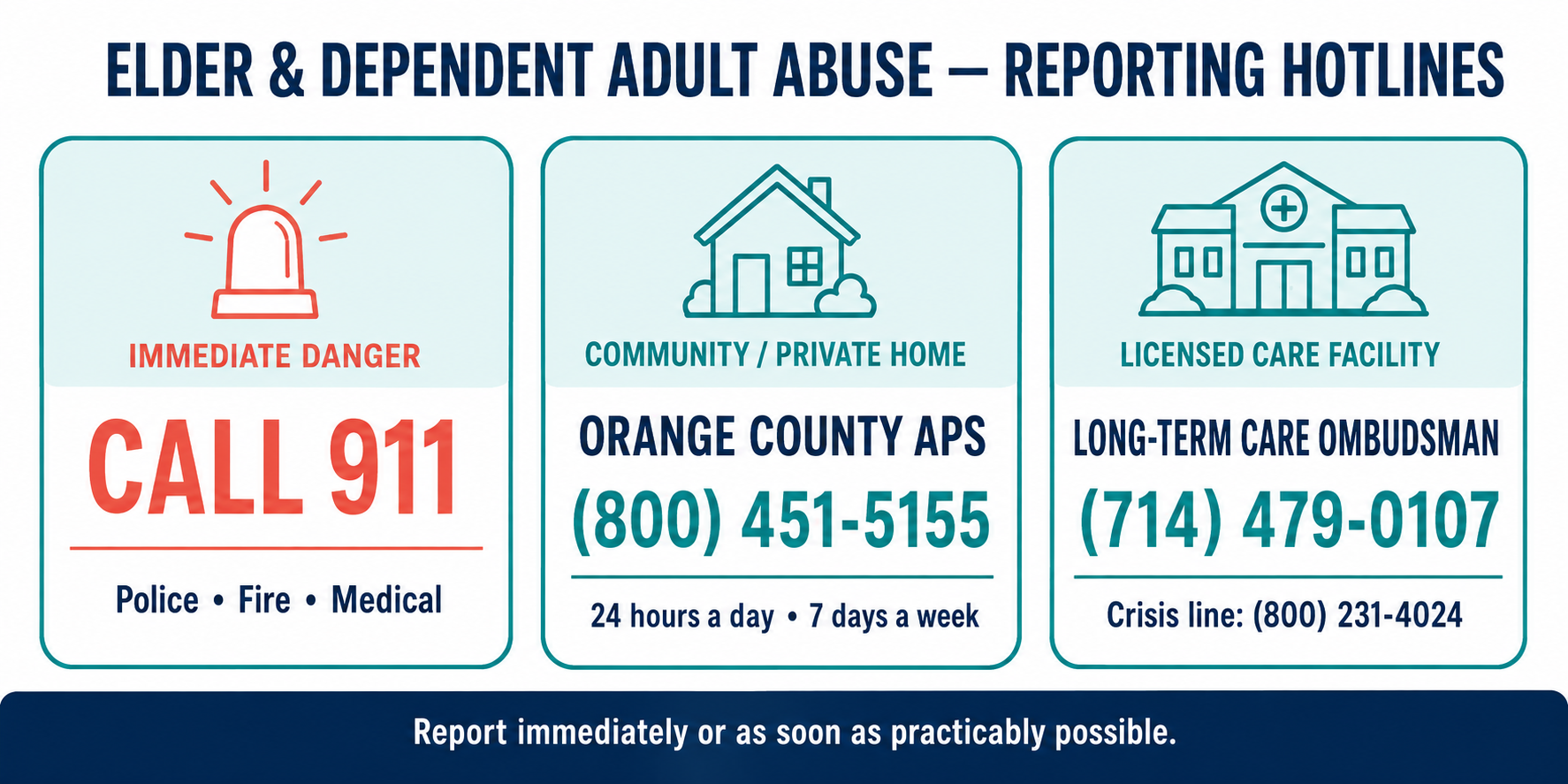
Emergency services: 911
Orange County Adult Protective Services (APS): (800) 451-5155 — 24 hours a day, 7 days a week
Long-Term Care Ombudsman Service: (714) 479-0107; crisis line: (800) 231-4024
SOC 341 Report of Suspected Dependent Adult/Elder Abuse and instructions
California Department of Social Services Adult Protective Services
California Welfare and Institutions Code § 15610.07 and § 15630
Besa Health medical record and approved incident-reporting process
✅ Before You Start
If there is immediate danger, a life-threatening condition, or an active threat, call 911. Move the patient or customer to a safe area when possible, provide care within your role and training, and remain with the person while the emergency response is active.
Speak with the person privately whenever it can be done safely. Do not confront the suspected abuser, promise secrecy, conduct your own investigation, or delay a required report while seeking internal approval.
A person experiencing abuse or neglect should be encouraged to tell a doctor, trusted friend, or family member, or to call the appropriate helpline. A witness or person with reasonable suspicion should report the concern.
Report each new or repeated incident. Every report is a snapshot of what is known at that time; an earlier report does not replace the duty to report a later incident.
🚀 Tips & Tricks
Use the elder’s or dependent adult’s exact words. Record objective observations and facts without blame, assumptions, or conclusions.
Ask simple, respectful, non-leading questions in private. Do not repeatedly question the person or press for details beyond what is needed for care, safety, and reporting.
Have the person’s identifying and location information, the alleged abuse or neglect, the date and place of the incident, the alleged abuser’s information when known, injuries or immediate risks, and the reporter’s contact information ready.
If a form item is unknown, enter “unknown.” Do not delay the immediate telephone or authorized confidential internet report while gathering missing information.
📘 Instructions
Step 1: Ensure Immediate Safety And Privacy
Assess for immediate danger, urgent medical needs, suspected sexual assault, significant injury, unsafe discharge, and whether the suspected abuser is present.
Call 911 for immediate danger or a medical emergency. Provide care within scope and stay with the patient or customer during the active emergency response.
When safe, move the person to a private setting. Limit access to the person and information to staff involved in treatment, safety, and required reporting.
Notify the appropriate Besa Health leader for operational support, but do not delay or replace the external report required of the mandated reporter.
Step 2: Understand Elder And Dependent Adult Abuse
California Welfare and Institutions Code § 15610.07 defines abuse of an elder or dependent adult to include physical abuse, neglect, financial abuse, abandonment, isolation, abduction, or other treatment resulting in physical harm, pain, or mental suffering, and deprivation by a care custodian of goods or services necessary to avoid physical harm or mental suffering.
In practical terms, abuse includes neglecting, exploiting, or inflicting painful or harmful mistreatment on an elder or dependent adult. It may involve physical, emotional, or sexual harm, financial exploitation, or neglect of the person’s welfare by someone directly responsible for care.
Abuse often occurs where the elder lives. The abuser may be an adult child, grandchild, other relative, spouse, or partner. Abuse can also occur in an institutional setting, especially a long-term care facility.
Step 3: Recognize The Forms Of Abuse
Physical abuse is non-accidental use of force that causes pain, injury, or impairment. It includes hitting or shoving and inappropriate use of drugs, restraints, or confinement.
Emotional abuse is treatment that causes emotional or psychological pain or distress. It includes intimidation by yelling or threats; humiliation or ridicule; habitual blaming or scapegoating; ignoring the elder; isolating the person from friends or activities; and terrorizing or menacing.
Sexual abuse is nonconsensual sexual contact of any kind. It also includes showing pornography, forcing the person to watch sexual acts, or forcing the person to undress.
Neglect is failure to fulfill a caretaking obligation. It may be intentional or unintentional, including when a caregiver is ignorant of or denies how much care the person needs. The source protocol notes that neglect accounts for more than half of reported elder-abuse cases.
Financial exploitation is unauthorized use of an elder’s or dependent adult’s funds or property by a caregiver or an outside scammer. Examples include misusing checks, credit cards, or accounts; stealing cash, income checks, or household goods; forging a signature; and identity theft.
Common scams include demanding a fee to claim a “prize,” soliciting for a phony charity, and investment fraud.
Healthcare fraud or abuse by unethical clinicians, staff, or professional care providers includes charging for care not provided; overcharging or double billing; accepting kickbacks; overmedicating or undermedicating; recommending fraudulent remedies; and committing Medicaid or Medi-Cal fraud.
Step 4: Identify Risk Factors
Caregiving can be satisfying and enriching, but escalating demands can cause significant stress, burnout, or impatience that increases the risk of neglect or lashing out.
Risk factors include caregiver depression; lack of support; viewing care as burdensome or emotionally unrewarding; caregiver substance abuse; the intensity of the elder’s illness or dementia; and social isolation.
Additional risk factors include an elder who was previously an abusive parent or spouse; a history of domestic violence; and verbal or physical aggression by the elder.
Institutional caregiver risk factors include lack of training, too many duties, being unsuited to caregiving, and poor working conditions.
Risk factors do not prove abuse. Use them to heighten awareness, assess safety, and support objective reporting of observed, known, disclosed, or reasonably suspected abuse.
Step 5: Apply The Mandated-Reporter Duty
A mandated reporter includes a person who has assumed full or intermittent responsibility for the care or custody of an elder or dependent adult, whether paid or unpaid, including administrators, supervisors, licensed facility staff, care custodians, health practitioners, clergy members, and employees of county APS or local law enforcement agencies.
A mandated reporter must report when, in a professional capacity or within the scope of employment, the reporter observes or knows of an incident that reasonably appears to be abuse or neglect, receives visual or audible information or other evidence suggesting abuse, is told by an elder or dependent adult that abuse or neglect occurred, or otherwise reasonably suspects abuse or neglect.
The reporting duty covers known or suspected physical abuse, sexual abuse, financial abuse, abduction, neglect including self-neglect, isolation, and abandonment.
The mandated reporter has a personal legal duty to report. Do not wait for proof, do not investigate before reporting, and do not allow a supervisor or another person to impede or excuse the report.
Step 6: Make The Immediate Report
Make the verbal report by telephone, or use an authorized confidential internet reporting tool when one is available, immediately or as soon as practicably possible.
For abuse in the community or a private home in Orange County, call Orange County APS at (800) 451-5155. The hotline is available 24 hours a day, 7 days a week.
For abuse in a licensed care facility, including a nursing home or board-and-care facility, call the Long-Term Care Ombudsman Service at (714) 479-0107. The statewide crisis line is (800) 231-4024.
For an emergent situation, notify local law enforcement or call 911. Follow the current SOC 341 instructions for the receiving agencies and timeframes that apply to the setting and incident.
For applicable abuse in a long-term care facility or state facility, report to local law enforcement immediately and no later than two hours when required. The current SOC 341 instructions specify when the two-hour and 24-hour facility-reporting rules apply.
Document the date and time, receiving agency, name or identification of the person receiving the report when available, and any report or case number provided.
Step 7: Complete And Submit SOC 341
Open the current SOC 341 Report of Suspected Dependent Adult/Elder Abuse. Complete the form for each known or suspected instance of abuse or neglect.
If the initial report was made by telephone, send the written SOC 341 or complete an authorized confidential internet report to APS or law enforcement within two working days.
If the abuse occurred in a long-term care facility, follow the current SOC 341 instructions for reports to local law enforcement, the local Long-Term Care Ombudsman Program, and the appropriate licensing agency. Some facility reports require written submission within 24 hours.
Do not delay the immediate verbal report while completing the form. Keep any permitted copy according to Besa Health privacy, security, and record-retention requirements.
Step 8: Support The Person And Report Future Incidents
Encourage a person who is being abused, neglected, or exploited to tell a doctor, trusted friend, or family member or to contact APS, the Ombudsman, or emergency services as appropriate.
A person who witnesses or reasonably suspects abuse should report it. Non-mandated relatives, neighbors, friends, and other community members may call the appropriate agency even when they are not required to complete paperwork.
Continue to report future incidents. Do not assume the agency already knows what happened or that a prior report covers a new event.
Share resources in a way that does not increase danger. Confirm whether a telephone call, voicemail, printed handout, portal message, or follow-up contact is safe.
Step 9: Document The Medical Record
Document the person’s exact words, objective findings, injuries or signs of neglect, behavior and emotional state, relevant history, care provided, immediate safety actions, and disposition.
Document the basis for reasonable suspicion; the date and time of each external report; the receiving agency and contact; any report number; the written or internet follow-up; resources offered; and follow-up plan.
Do not place unsupported conclusions in the record. Protect the reporter’s and patient’s confidential information according to law and Besa Health policy.
🛠 Troubleshooting
The Person Is In Immediate Danger
Call 911, provide urgent care within scope, move the person to safety when possible, and stay with the person while the emergency response is active.
The Suspected Abuser Is Present
Do not confront the person. Use a neutral, clinically appropriate reason to speak privately with the elder or dependent adult, involve law enforcement when needed, and protect safe contact and location information.
The Person Denies Abuse Or Does Not Want A Report
Listen respectfully and do not pressure the person. Explain the mandated-reporting duty calmly. A mandated reporter must still complete a legally required report based on observation, knowledge, disclosure, evidence, or reasonable suspicion.
The Correct Receiving Agency Is Unclear
Call Orange County APS at (800) 451-5155 for community settings or the Long-Term Care Ombudsman at (714) 479-0107 for licensed care facilities. If danger is immediate, call 911. Ask the receiving agency for routing assistance without delaying the report.
The Form Or Website Is Unavailable
Make the telephone report immediately or as soon as practicably possible. Obtain the current SOC 341 from the California Department of Social Services Adult Protective Services page or the receiving agency and submit the required follow-up within the applicable deadline.
The Incident Has Already Been Reported
Report any new or repeated incident and any materially new information. Each report documents what is known at that time; do not rely on an earlier report to cover a later event.
✅ Completion Check
Immediate safety and urgent medical needs were addressed, and the person was not left alone during an active emergency response.
The person was interviewed privately when safe, and observations, disclosures, and evidence were documented objectively.
All applicable forms of abuse and risk factors were considered without treating risk factors alone as proof.
The mandated reporter’s immediate telephone or authorized confidential internet report was completed with the correct receiving agency.
Any applicable local-law-enforcement, Ombudsman, licensing-agency, two-hour, or 24-hour reporting requirement was completed.
If the first report was by telephone, SOC 341 or an authorized confidential internet follow-up was submitted within two working days.
The medical record contains reporting details, care and safety actions, resources, disposition, and follow-up.
Any new or repeated incident will be reported separately.
References
Forms: SOC 341 Report of Suspected Dependent Adult/Elder Abuse and instructions • California Adult Protective Services forms
Reporting: Orange County Making An Adult Protective Services Report • Orange County Mandated Reporters Guidance • California Adult Protective Services • Long-Term Care Ombudsman
Law: California Welfare and Institutions Code § 15610.07 • California Welfare and Institutions Code § 15630
Source: CalOptima Provider FSR/MRR Binder, pages 103–105 • Revised June 18, 2020
Comments (0)