
📚Definitions
- Spondylosis: Arthritis of the spine, seen as disc space narrowing and facet joint changes.
- Anterolisthesis: Anterior displacement of a vertebral body.
- Spondylolisthesis: Anterolisthesis secondary to spondylolysis or other causes.
- Retrolisthesis: Posterior displacement of a vertebral body.
- Spondylolysis: Fracture in the pars interarticularis, often at L5.
- Spinal Stenosis: Narrowing of the vertebral canal, causing nerve compression.
- Radiculopathy: Nerve root impairment causing pain, numbness, or weakness.
- Sciatica: Pain radiating along the sciatic nerve.
- Cauda Equina Syndrome: Loss of bowel/bladder control, saddle anesthesia, and leg weakness.
- Kyphosis/Lordosis/Scoliosis: Abnormal spinal curvatures.
🗺️ Overview
Low Back Pain (LBP) is the second most common symptom causing adults to seek medical care in the US. Episodes of acute LBP are usually benign and self-limited, resolving within four to six weeks. Recurrent or chronic LBP can be physically and psychologically disabling. While rare, serious conditions like cauda equina syndrome, spinal cord compression, infection, or malignancy should be considered based on history and examination.
🚨 Important History
- Age: >50 years increases risk for systemic causes.
- Symptoms: Nature (dull, sharp), intensity, duration, location, radiation, paresthesias, weakness, bowel/bladder changes.
- Triggers: Overexertion, trauma, infection, psychosocial factors.
- Exacerbating/Alleviating Factors: Pain with movement, Valsalva, standing/sitting.
- Medical History: Cancer, osteoporosis, rheumatologic conditions, prior surgeries.
- Medications: Steroids (compression fracture risk), opioids, immunosuppressants.
- Lifestyle: Smoking, activity level, occupation.
📹 Video Examination
- General Appearance: Body habitus, signs of distress, diaphoresis.
- Posture and Inspection: Observe for asymmetry, rashes, bruising.
- Pain Localization: Lumbar, sacral, sciatic, etc.
- Range of Motion: Torso and extremity movements that exacerbate pain.
- Functional Tests: Walking, squatting (L4), heel/toe walking (L5/S1).
- Special Tests: Straight leg raise (radiculopathy), palpation for tenderness.
🎯 Diagnosis
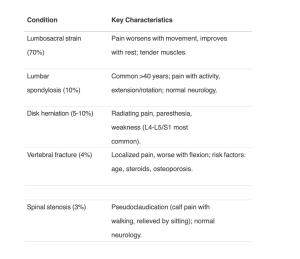
Red Flags for Serious Conditions
- Cauda equina syndrome (bowel/bladder dysfunction, saddle anesthesia).
- Infection (fever, IV drug use, recent procedure).
- Malignancy (unintentional weight loss, history of cancer).
- Fracture (trauma, osteoporosis, steroid use).
💆 Treatment
Non-Pharmacological Therapies
- Early mobilization: Avoid bed rest.
- Exercise: Stretching/strengthening once pain is manageable.
- Heat therapy: For muscle relaxation.
- Weight management: If applicable.
Pharmacological Management
- First-line: NSAIDs (e.g., ibuprofen 200-400 mg Q4-6H PRN, naproxen 220 mg Q8-12H PRN).
- Alternatives: Acetaminophen (1g QID PRN; caution in liver disease).
- Muscle relaxants: Short-term use (e.g., tizanidine 2-4 mg TID for 2-3 days; sedation risk).
- Avoid: Oral steroids (no evidence for acute LBP without radiculopathy).
Referral Indications
- Refractory symptoms >6 weeks.
- Red flags (e.g., cauda equina, infection, fracture).
- Neurologic deficits (weakness, progressive radiculopathy).
🧪 Diagnostic Tests
- Avoid routine imaging for uncomplicated LBP.
-
Consider if red flags:
- Labs (CBC, CRP, PSA, TSH).
- MRI/CT for suspected malignancy, infection, or neurologic compromise.
🔮 Follow Up
- Expect improvement within days, resolution by 2 weeks.
- Re-evaluate if no improvement or worsening symptoms.
📘 Coding
ICD-10 Codes
- M54.5: Lumbago.
- M54.9: Dorsalgia.
- M51.36: Degenerative disc disease, lumbar.
- M54.30-M54.32: Sciatica.
- M62.830: Muscle spasm of back.
If you have any questions or would like more information, please reach out to the Delegating Physician.
Comments (0)